

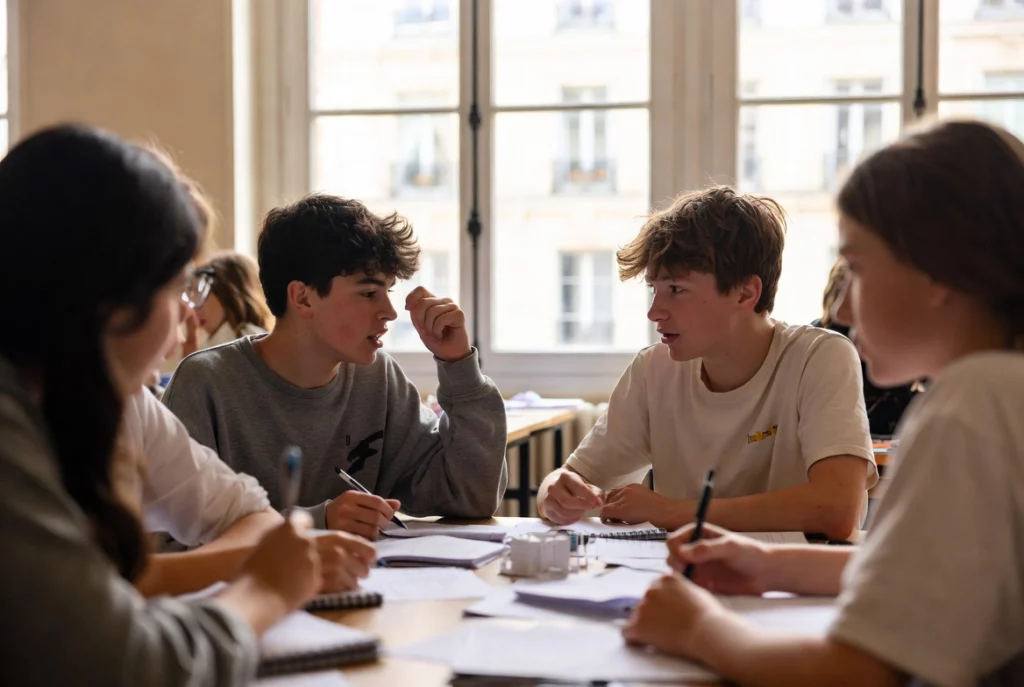
Have you ever wondered whether traditional education methods are still suited to students’ needs? Or why innovative teaching approaches are so widely discussed in schools today? Perhaps also: how can we develop autonomy, motivation, and critical thinking in the classroom?
These questions are entirely legitimate and frequently cross parents’ minds. Drawing on the great educators of the 20th century and contemporary research in the educational sciences, the use of innovative teaching methods places the student at the heart of learning. In this article, our bilingual school in the 16th arrondissement offers some educational insight to help you understand the rationale behind these methods and how they are put into practice in school.
The key takeaways
Innovative teaching methods are attracting growing interest in the world of education. Here are the main points to keep in mind in order to understand what they concretely bring to educational practice.
- Traditional pedagogy shows certain limitations in the face of today’s educational needs, particularly regarding student engagement, the diversity of learning profiles, and the development of complex skills.
- A teaching approach is described as innovative when it genuinely improves learning, by introducing new pedagogical practices adapted to students’ needs.
- Innovative teaching methods place the student at the center of the learning process, encouraging experimentation, collaboration, and active participation.
- They make it possible to develop essential skills, such as critical thinking, cooperation, creativity, or problem-solving ability.
- Many methods are already in practice, such as the flipped classroom, problem-based learning, or learning through argumentation.
- Pedagogical innovation is part of a gradual evolution of the school, which seeks to better address contemporary educational challenges and the varied needs of students.
The limitations of traditional pedagogy
Having discussed the emergence of innovative teaching methods in schools, it is useful to understand why certain educational practices are now being questioned. Long based on a top-down transmission of knowledge ( the teacher explains, the student listens and then reproduces ) this model has contributed greatly to spreading instruction, but it now shows certain limitations in the face of contemporary educational needs.
A role that is still too passive for the student in learning
In the traditional pedagogical model, the teacher occupies a central place in the transmission of knowledge. Students are often placed in a posture of listening and absorbing knowledge.
Yet, as early as the beginning of the 20th century, several educators questioned this organization. Figures such as Maria Montessori and Célestin Freinet already championed the idea that children learn more effectively when they act, experiment, and participate actively in the activities offered to them.
When students remain primarily recipients of information, their engagement may diminish and learning may become more superficial. Conversely, learning situations that involve discussion, experimentation, or problem-solving often foster a more lasting grasp of knowledge.
Assessment methods focused on memorization
Traditional pedagogy often relies on assessments designed to check the recall of knowledge : definitions, rules, or dates. These assessments measure the acquisition of fundamental knowledge, but they do not always reflect students’ ability to apply that knowledge in complex situations.
Yet educational systems today also expect students to develop skills in analysis, argumentation, and problem-solving. This sometimes means diversifying the forms of assessment, by incorporating, for example, projects, presentations, or group work.
A difficulty in accounting for the diversity of learning profiles
Classes bring together students with very different paces and ways of learning. In a uniform pedagogical model, some students may struggle while others risk lacking stimulation.
This heterogeneity is now a major challenge for teachers. It is precisely with this in mind that many pedagogical reflections seek to develop more flexible practices, capable of better adapting to the varied needs and profiles of students.
At what point can a teaching approach be called innovative?
Pedagogical innovation is not limited to introducing a digital tool or an original activity in the classroom. Above all, it corresponds to a structural evolution of educational practices, designed to improve learning and respond more effectively to students’ needs.
Introducing a novelty that genuinely improves learning
In the field of educational sciences, pedagogical innovation is generally defined as the introduction of a new element, or a new way of organizing teaching, into an existing system in order to improve its results. The researcher Françoise Cros emphasizes that innovation aims to transform practices in order to meet an identified need and improve the quality of learning.
In other words, a practice only becomes truly innovative if it brings a tangible pedagogical improvement. It is not simply a matter of changing the tools or materials used, but of rethinking the way students acquire and apply their knowledge.
Placing the student at the center of the educational process
Another principle widely shared by innovative teaching methods is to place the student back at the heart of learning. This idea is part of the legacy of so-called “active” pedagogies, developed from the beginning of the 20th century by several educators who sought to adapt teaching to children’s real needs.
From this perspective, the teacher is no longer limited to transmitting knowledge. They create learning situations in which students can observe, experiment, argue, or collaborate. This active participation generally fosters a deeper understanding of the concepts studied and encourages the development of intellectual autonomy.
Relying on a collective and evaluated approach
Finally, pedagogical innovation in schools does not rest solely on isolated individual initiatives. It is often part of a collective dynamic, involving educational teams, institutions, and sometimes researchers in the educational sciences.
In many educational systems, these approaches are also accompanied by an evaluation that measures their effects on students’ learning and well-being. This dimension of analysis and feedback is essential : it makes it possible to identify the practices that are genuinely effective and to consider rolling them out on a larger scale.
The value of implementing an innovative teaching approach in school
Innovative teaching methods are not merely about a desire to modernize education. Above all, they respond to major educational challenges : preparing students for a constantly changing world, while taking into account their needs and ways of learning.
Developing the essential skills of the 21st century
Today, school is no longer limited to transmitting academic knowledge. It must also prepare students to operate in complex environments, where analysis, collaboration, and creativity play a central role.
Several pedagogical reflections thus highlight the importance of developing skills such as critical thinking, problem-solving ability, and cooperation. These skills enable students to use the knowledge they have acquired to understand new situations and adapt to different contexts.
Innovative teaching methods used, for instance, from our bilingual nursery school in the 16th arrondissement of Paris through to our bilingual middle school aim precisely to create learning situations in which students actively call upon these skills, for example through projects, debates, or research activities.
Fostering student engagement and motivation
Student engagement is a decisive factor in academic success. When learning takes the form of participatory activities, discussions, group work, experiments, students are generally more involved in their work.
The educators of the New Education movement already stressed the importance of arousing children’s interest and curiosity to foster learning. From this perspective, the student is no longer merely a recipient of knowledge : they participate actively in its construction.
This involvement often helps to develop a more positive relationship with knowledge, as well as greater confidence in one’s ability to learn.
Better meeting students’ individual needs
Classes bring together students with varied learning profiles : different paces, multiple interests, or diverse ways of understanding the concepts studied. Innovative teaching methods seek to better account for this diversity.
By diversifying activities, individual work, collaborative projects, guided research, or oral presentations, teachers can offer more flexible learning paths. This approach makes it possible to give each student different opportunities to apply their skills and progress at their own pace.
From this perspective, pedagogical innovation is also a means of building a more inclusive educational environment, capable of bringing out the potential of each individual.
5 examples of innovative teaching methods applied in the classroom
Innovative teaching methods can take very different forms depending on the school and the educational context. They are nonetheless based on a common idea: offering students learning situations that are more active and more concrete. Here are a few pedagogical approaches already in use in some schools.
Cross-over learning: connecting the classroom to the real world
Cross-over learning involves connecting school instruction to experiences lived outside the classroom. The goal is to combine formal and informal learning in order to give greater meaning to the knowledge being studied.
For example, the study of an artist can be extended by a visit to a museum, while work on the seasons can draw on observations made in nature. This type of approach allows students to anchor the concepts studied in concrete situations, which are often more memorable than reading a textbook alone.
By multiplying these links between theory and experience, cross-over learning helps to strengthen the understanding and retention of knowledge.
Learning through argumentation
Learning through argumentation is based on debate and the confrontation of ideas among students. Rather than immediately providing an answer, the teacher poses an open-ended question that invites students to reflect, discuss, and justify their points of view.
Students are thus led to call upon their knowledge, formulate hypotheses, and listen to others’ arguments. This approach fosters the development of critical thinking and the ability to argue : two skills that are essential in many areas of learning.
It also makes students more active in the construction of their knowledge.
Pedagogy 3.0
Pedagogy 3.0 is based on three key principles : autonomy, the permanence of learning, and creativity. In this model, students actively participate in building their own learning materials.
They can, for example, produce their own course summaries, create educational tools, or devise original materials to memorize certain concepts. This approach encourages students to make knowledge their own in a more personal way.
By becoming active participants in their learning, they also develop their ability to organize their work and express their ideas.
The flipped classroom
The flipped classroom changes the way learning time is distributed between home and school. Students familiarize themselves with the theoretical content beforehand, for example through readings or digital resources, and then use class time to apply that knowledge.
Class sessions can then be devoted to exercises, discussions, or collaborative activities, with the teacher’s support. This arrangement makes it possible to devote more time to explanation, practice, and deepening the concepts studied.
It also fosters interactions between students and teachers.
Problem-based learning
Problem-based learning invites students to work collectively on a complex situation whose solution they do not know in advance. In groups, they analyze the problem, search for information, and gradually develop an answer.
In this framework, the teacher acts primarily as a tutor or facilitator. They guide the students’ process without directly providing the solution.
This method helps to develop several important skills: information research, cooperation, the ability to structure a line of reasoning, and problem-solving.
Innovative teaching methods: what prospects for the school of tomorrow?
Innovative teaching methods are not intended to replace traditional methods, but to evolve educational practices in order to better meet students’ needs and the transformations of society. Several trends are emerging today in pedagogical thinking.
- A school more attentive to the child’s overall development. Contemporary pedagogical approaches give increasing importance to the social, emotional, and creative dimensions of learning, in order to foster students’ fulfillment and autonomy.
- Strengthened collaboration between research and pedagogical practice. The educational sciences and research on learning processes increasingly help to inform pedagogical practice and to better understand the conditions favorable to learning.
- Toward more flexible learning environments. Many schools are gradually experimenting with new pedagogical arrangements, capable of adapting to the varied profiles of students and to contemporary educational challenges.
Innovative teaching methods reflect a profound evolution of educational practice, aimed at better supporting students in a constantly changing world.
Within our international school in Paris, this pedagogical approach fits naturally into the school’s educational vision, which combines innovative teaching, individualized support, academic rigor, and a stimulating bilingual environment to enable each student to fully develop their potential.